AC Fan Not Spinning? Here's What's Actually Going On
Vardan Hovhannisyan
Co-Founder

Date & Time
You walk outside and the house already feels warmer than it should. The outdoor unit is sitting there, and the fan blade behind the top grille isn't moving. Maybe the unit is humming. Maybe it's dead silent. Either way, you're standing in Palm Beach County heat trying to figure out if this is a five-minute fix or the start of an expensive week, and you don't want to call someone who talks you into a part you don't need.
Here's the good news. A fan that won't spin almost always tells you something specific about what's wrong, once you know how to read it. This guide walks through the three real patterns, what each one means, the one test you can safely run yourself, and when it's time to stop touching it and call someone.
This shows up most in July and August, when the system runs almost around the clock and every component gets pushed the hardest. A capacitor or contactor that's been slowly wearing down all season tends to finally give out on the hottest afternoon of the week, not a mild one. That timing isn't bad luck. It's just wear catching up at the worst possible moment.
What It Means When the Outdoor Fan Won't Spin
Most homeowners call the whole outdoor box "the compressor." It's an easy habit, but it causes confusion here, because the compressor and the fan are two separate parts doing two separate jobs. The compressor pressurizes refrigerant. The fan pulls outside air across the condenser coil to carry away the heat that refrigerant is holding. When people say "my AC fan isn't spinning," they mean that fan, the one visible through the top grille of the outdoor unit.
A dead fan shows up in one of three patterns, and each one points somewhere different:
The fan hums but doesn't turn.
The whole outdoor unit is silent, no hum, no movement.
The fan spins just fine, but something else about the system is off.
Match your situation to one of the sections below before doing anything else.

The Fan Hums But Won't Start
A humming outdoor unit with a fan that isn't turning points to one of two things: a failing run capacitor or a seized motor bearing. The capacitor stores and releases the jolt of electricity that gets the fan motor spinning. When it weakens, the motor gets enough power to hum and vibrate but not enough to actually start turning, according to Trane's troubleshooting guide for AC fans. A seized bearing produces a similar sound. The motor tries to turn, can't overcome the friction, and hums in place instead.
Simple Action has a full breakdown of what bad capacitor symptoms sound and look like, including the read-the-number test that tells you how far gone it is, in Bad AC Capacitor Symptoms: Read the Number Yourself. If your unit is humming, start there.
The Fan Is Completely Silent
No hum, no movement, nothing. That means power isn't reaching the fan circuit at all, and it traces back to one of three places: the breaker, the outdoor disconnect box, or a failed contactor.
The contactor is the switch inside the outdoor unit that sends power to both the fan and the compressor whenever your thermostat calls for cooling. When it wears out or its contacts burn, the whole outdoor unit loses power at once, according to ARS's diagnostic guide for AC fans. That's different from a bad capacitor, since a failed contactor usually produces total silence instead of a hum.
If your breaker keeps tripping specifically, every time you reset it, that's a distinct pattern with its own causes, and Simple Action covers it in Why Your AC Keeps Tripping the Breaker (And When It's Safe to Reset It). And if nothing in the system runs at all, not just the outdoor fan but the thermostat and the indoor blower too, that's a broader electrical problem covered in Why Your AC Won't Turn On.
The Fan Spins, But Something's Still Wrong
Sometimes the fan looks fine and the real problem sits somewhere else entirely. Two patterns show up often enough to name on their own.
The Fan Spins, the Compressor Doesn't
The outdoor fan turns normally, but you never hear the compressor's deeper hum kick in, and the air from your vents stays warm. This is a different, more serious problem than a dead fan. It usually points to the compressor itself, its own capacitor, or a refrigerant issue. Simple Action's guide to AC short cycling covers a related pattern where the system starts and stops on its own, and it shares some of the same root causes.
The Fan Is Dead, But Air Is Still Blowing Inside
This is the pattern that confuses people the most. Your indoor blower runs on its own circuit, separate from the outdoor unit. The vents keep pushing air even after the outdoor fan and compressor have both stopped. The air just stops being cold, usually within a few minutes, because nothing outside is removing heat from the refrigerant anymore. If you're feeling air movement without real cooling and you're not sure the outdoor unit is even the cause, Simple Action's broader guide on why your AC isn't blowing cold air covers the other common reasons.

The One Safe Test You Can Do Yourself (and When to Stop)
There's exactly one check a homeowner can safely run without tools or training. Shut the system off at the thermostat, then cut power at the breaker or the outdoor disconnect. Wait a minute, then reach through the top grille and try turning the fan blade by hand.
A blade that spins freely tells you the motor and bearings are fine, which points back toward the capacitor or the power supply. A blade that's jammed or won't turn at all often means debris, a stick, storm damage, or a nest caught in the fan cage. Keeping the area around the unit clear helps prevent this in the first place. The Department of Energy recommends trimming vegetation back at least two feet from the outdoor unit to keep airflow and the fan cage clear, according to its guidance on maintaining a home air conditioner.
That's the whole test. Don't open the unit's electrical panel, don't touch anything inside the cabinet, and don't keep running the system while you troubleshoot. Turn the blade by hand, restore power, and see what happens. If the fan still won't start, stop there and call for service.
Running the system with a dead condenser fan is worth avoiding entirely. Without airflow across the condenser coil, the compressor can overheat, and that overheating can cause lasting compressor damage, according to Carrier's guidance on AC fan failures. A capacitor or contactor is a straightforward repair. A damaged compressor is not. Shutting the system off protects the more expensive part while you sort out the smaller one.
What Determines Whether This Is a Quick Fix or a Bigger Repair
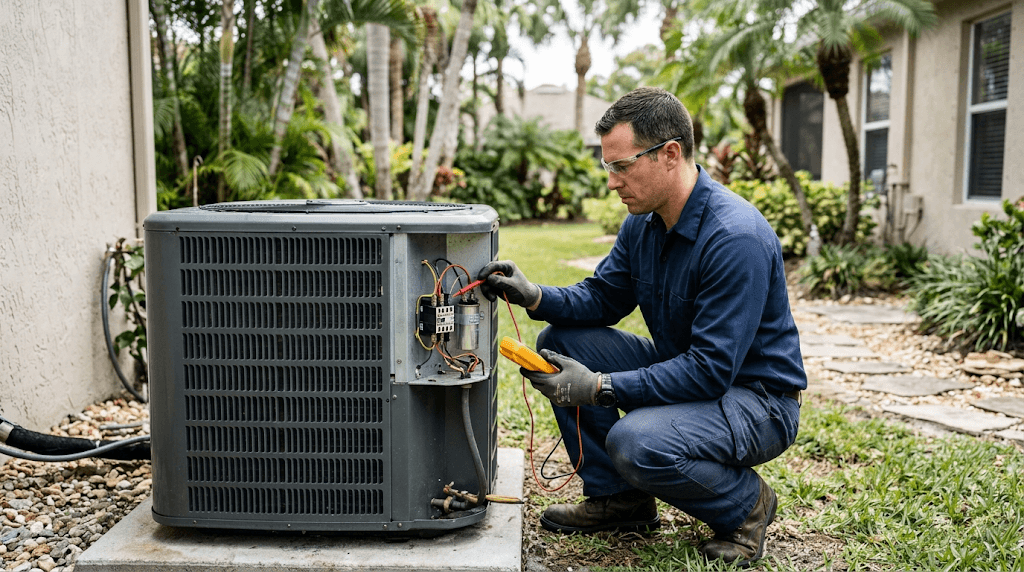
A technician walks through the same fork you just did, just with meters instead of guesswork. They test the capacitor's rating against its stamped value, check the contactor for pitting or burned contacts, and confirm the motor draws the right amperage before ruling it bad. Most of the time, a fan that hums but won't start is a capacitor, and that's a same-visit fix. A silent unit is usually a contactor or a breaker issue, also typically resolved in one visit. A motor that's actually burned out takes longer, since it has to be matched to your system before it's replaced.
Simple Action doesn't play games with any of that. Every visit comes with an upfront pricing promise before any work starts, a narrow on-time arrival window, and a satisfaction guarantee once the job is done. You'll know what's wrong, what fixing it involves, and what to expect before anyone touches your unit. That's the whole point of one call, one price, one visit.
If this is the second or third part that's failed on the same system in a few years, that's worth mentioning to your technician too. A pattern of repeat electrical failures, especially capacitors and contactors going out faster than they should, is often a sign the system needs a closer look rather than another one-off part swap. Regular maintenance catches a weak capacitor or a pitted contactor before it strands you outside in the heat trying to figure out which one it is. Homeowners on Simple Action's Simple Care Club maintenance plan get that kind of check built in, rather than finding out the hard way.
If your outdoor fan still won't start after the breaker reset and the hand-spin test, Simple Action can take it from there. Schedule AC repair and get a straight answer, not a guess.
Frequently Asked Questions
How do I know if it's the capacitor or the motor?
A hum with no movement usually points to the capacitor. A silent unit where the blade won't turn freely by hand, even with power off, usually points to the motor itself. Bulging or leaking on the top of the capacitor's metal case is another visible clue, if you can see it safely from outside the unit without opening anything. A technician confirms which one it is with a simple amperage and capacitance test, in a few minutes, without guessing.
How do I reset my outside AC fan?
Cut power at the thermostat and the breaker, wait about a minute, then restore power and see if the fan starts. If it doesn't, or if it trips again, stop resetting it. Simple Action has full reset steps, including when a second reset is a warning sign, in How to Reset an AC Unit, and When the Second Reset Is a Warning.
Is it safe to turn the fan blade by hand to test it?
Yes, as long as the system is fully powered off at the breaker or outdoor disconnect first. Never reach into the unit while it's running or while power is still connected.
Can leaves or debris stop the AC fan from spinning?
Yes. Leaves, mulch, a stray branch, or storm debris caught in the fan cage can jam the blade completely. It's one of the most common causes after a storm rolls through, when wind scatters yard debris straight into the unit. Keeping the area around the unit clear of buildup, and giving it a look after any significant wind or rain, is one of the simplest ways to prevent this exact problem.
How much does it cost to fix an AC fan that won't spin?
Simple Action doesn't quote prices without seeing the unit first, since guessing over the phone is how homeowners end up upsold on parts they don't need. What you get instead is an upfront pricing promise before any work starts, a narrow on-time arrival window, and a satisfaction guarantee on the finished repair.


