Why Is My AC Not Blowing Cold Air?
Vardan Hovhannisyan
Co-Founder

Date & Time
It's 95 degrees outside, the vents are running, and the air coming out feels like a warm breath on the back of your neck. That sinking feeling is familiar to almost every homeowner in Palm Beach County. Here's the good news before you assume the worst. Most of the time, an AC that runs but does not cool traces back to a short list of causes, and a few of them you can rule out yourself in about five minutes.
This guide walks through those causes in order, starting with the free fixes and ending with the failures that need a licensed technician. We sell honest answers here, not fear, so we'll tell you exactly where the line sits between a do-it-yourself reset and a real service call.

Warm air from the vents on a hot day usually points to one of six common causes.
Start here: is it blowing warm air, or barely blowing at all?
Before you touch anything, notice which problem you actually have. They point in different directions.
If air comes out of the vents with normal force but feels warm or room temperature, the issue lives on the cooling side. Think refrigerant, a frozen coil, or the outdoor unit. If the air feels cool enough but barely trickles out, the issue is airflow. Think a clogged filter, a blocked return, or a duct problem. And if nothing blows at all, you're looking at power, the thermostat, or the blower motor.
Hold that distinction in your head as you work through the list. It tells you which section to trust most.
The fixes you can check yourself in five minutes
Roughly half the "no cold air" calls we get in Palm Beach County come down to something a homeowner can spot without tools. Run through these first.
Check the thermostat. Confirm it's set to Cool, not Fan or Heat, and that the target temperature sits a few degrees below the room reading. Dead batteries throw off the whole system, so swap them if the screen looks dim or blank.
Look at the breaker. A modern AC runs on two breakers, one for the indoor air handler and one for the outdoor unit. If the outdoor breaker tripped, the fan inside keeps blowing room-temperature air while the compressor sits dead. Reset it once. If it trips again, stop and call a pro, because a repeat trip signals an electrical fault.
Replace the air filter. A filter packed with dust starves the system of airflow. The U.S. Department of Energy notes that a dirty filter is one of the most common reasons a unit loses cooling performance, and that swapping it is the single most effective maintenance step a homeowner takes. Read more in the Department of Energy guide to maintaining your air conditioner. In our humid climate, plan on a fresh filter every one to two months.
Open the vents and returns. Closed supply vents and furniture parked over a return register choke airflow. Walk the house and clear them.
Clear the outdoor unit. Grass clippings, mulch, and storm debris pile against the condenser coil and trap heat. Give it two feet of clearance on all sides and rinse the fins gently with a hose.
Work through those five and a good share of warm-air problems solve themselves. If the air is still warm, the trail leads to the next three causes, and those need more care.
Frozen evaporator coil: the ice you can't see
This one surprises people. Your AC stops cooling because part of it froze solid, in July, in Florida. The evaporator coil sits inside the air handler and gets cold by design. When airflow drops or refrigerant runs low, the coil gets too cold, condensation on it freezes, and a block of ice forms over the very surface that's supposed to pull heat out of your air. The fan keeps running and pushes warm air past the ice.
You won't always see the coil, but the signs are clear. Look for frost on the copper refrigerant line near the outdoor unit, water pooling around the air handler as the ice melts, or a hissing system that runs nonstop without cooling.
The fix starts with patience. Turn the system off at the thermostat, switch the fan to On to push warm household air across the coil, and give it time to thaw fully. A heavy coil takes several hours to clear. Once it's thawed, replace the filter and run the system again. If it freezes a second time, you have a deeper airflow or refrigerant problem, and that's a technician's job. Never chip at the ice, because you'll puncture the coil and turn a service call into a replacement.
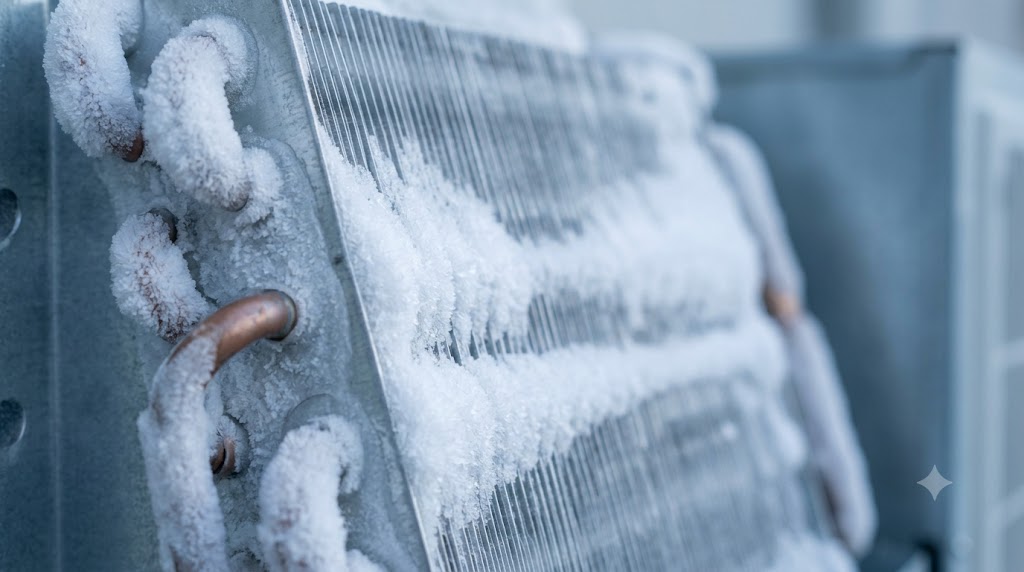
A frozen coil pushes warm air past a block of ice. Thaw it fully before running the system again.
Low refrigerant, and the recharge scam to watch for
Here's a fact that protects your wallet. Refrigerant does not get used up. It circulates in a sealed loop and never burns off like fuel. So when a technician tells you the system is low and needs a recharge, what they're really telling you is that the loop has a leak somewhere. A recharge without finding and fixing that leak buys you a few weeks of cooling before you're right back where you started.
This matters more in Palm Beach County than almost anywhere. Salt air corrodes the thin aluminum and copper of coils and refrigerant lines, and that corrosion opens the pinhole leaks that drain a charge. Homes within a mile or two of the water see it constantly. We wrote a fuller breakdown of how the coast shortens equipment life in our guide to how long AC units last in coastal Florida.
Refrigerant work is regulated for a reason. Under federal rules, only an EPA-certified technician handles refrigerant, and the law requires proper recovery and leak repair. That keeps the chemical out of the atmosphere and keeps you from paying for the same problem twice. An honest company finds the leak, shows you where it is, and gives you a straight repair-versus-replace assessment. A dishonest one tops off the charge, collects the fee, and waves goodbye. If you want to know the other red flags, we cover them in our piece on AC repair scams in Palm Beach County.
Compressor, capacitor, and contactor: when it's the outdoor unit
Walk outside and put your hand near the condenser. If the big outdoor fan isn't spinning and the unit sits silent while the indoor fan blows warm air, the failure lives out there. Three parts cause most of these.
The capacitor is a small cylinder that gives the motors the jolt they need to start. It's the most common outdoor failure, it dies quietly in our heat, and a technician swaps it quickly. The contactor is the electrical switch that tells the compressor to run, and pitted contacts stop the signal cold. The compressor itself is the heart of the system, the part that actually pressurizes refrigerant, and a failed one is the most serious diagnosis on this list. When the compressor goes on an older system, replacement of the unit often makes more sense than a repair, and a straight technician walks you through that math instead of pushing one answer.
None of these are do-it-yourself fixes. The outdoor unit holds enough stored electrical charge to hurt you even when the power is off. This is the point to call for professional AC repair.
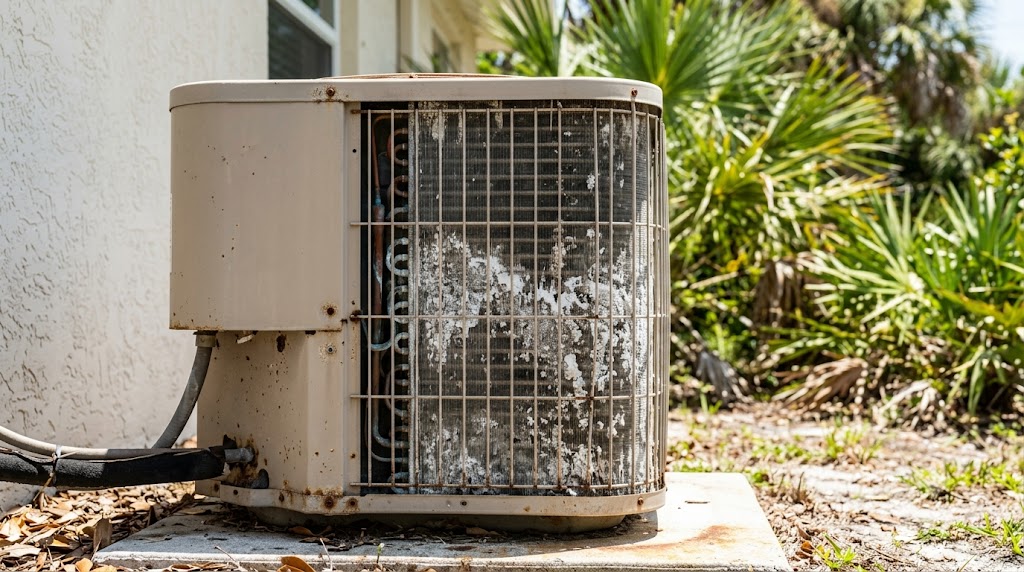
Salt air corrodes coils and electrical contacts, which is why coastal systems fail sooner.
Why Palm Beach County AC systems quit cooling more often
Florida is hard on air conditioners in ways the rest of the country never sees. Your system runs close to year round, so it logs the runtime hours of a northern unit twice over. The humidity load means it works harder to pull moisture out of the air, not just heat. And the salt air near the coast eats at coils and electrical contacts from the outside in.
Add it up and the average coastal system here ages faster than the label promises. A unit rated for 15 years on a spec sheet often gives 8 to 10 years of honest cooling within sight of the water. That faster wear is exactly why small problems, a weak capacitor, a slow refrigerant leak, a neglected filter, show up here as a warm-air emergency on the hottest afternoon of the year. Regular AC maintenance and tune-ups catch most of them before they leave you sweating.
When to call for service
Call a technician when you've replaced the filter and reset the breaker and the air is still warm, when the system freezes up a second time after thawing, when the outdoor fan sits dead, or any time you smell something burning. Those are not wait-and-see situations in a Florida summer.
A proper diagnosis looks like a technician measuring the refrigerant charge, checking the capacitor and contactor, inspecting the coil, and then telling you plainly what failed and what the honest fix is. No vague "it needs a recharge," no pressure to replace a system that has years left. When the heat won't wait, our 24/7 emergency AC service covers Palm Beach County day and night. Simple Action is licensed under Florida AC Contractor License CAC1824605, and every visit comes with our upfront pricing promise, a narrow on-time arrival window, and respect for your home. One call, one price, one visit.
Frequently asked questions
Why is my AC running but not cooling the house?
The fan and the cooling side run on separate parts, so the system blows air even when it stops cooling. The usual culprits, in order, are a clogged filter, a tripped outdoor breaker, a frozen evaporator coil, low refrigerant from a leak, or a failed capacitor or compressor. Start with the filter and the breaker, then work down the list.
Can a dirty air filter really stop my AC from blowing cold air?
Yes, and it's one of the most common causes we see. A clogged filter starves the coil of airflow, which drops cooling performance and freezes the coil in bad cases. In our humid climate, a fresh filter every one to two months keeps airflow strong and prevents the freeze.
Why is my AC blowing cold air outside but warm air inside?
That pattern points to an airflow or duct problem rather than the cooling system itself. A blocked return, closed vents, a dirty filter, or leaky ductwork in a hot attic lets the cooled air lose its chill before it reaches the rooms. Check the filter and vents first, then have the ducts inspected if the rooms stay warm.
How long should I wait after turning my AC off to reset it?
Give the compressor at least five minutes before you restart it, so internal pressures settle and you don't damage the motor. If you turned the system off to thaw a frozen coil, that's a different timeline. Plan on several hours with the fan running before the ice clears fully.
Should I add refrigerant myself if my AC isn't cooling?
No. Refrigerant is regulated, and federal law requires an EPA-certified technician to handle it. A low charge also means the sealed loop has a leak, so adding more without finding the leak wastes money and harms the environment. Have a professional find the leak and repair it the right way.