Why Does My AC Smell Musty? Palm Beach County Guide
Vardan Hovhannisyan
Co-Founder

Date & Time
Why Does My AC Smell Musty? A Palm Beach County Guide to the Real Causes
You open the front door after a week away, or the AC kicks on for the first time this evening, and there it is: that damp, musty smell. No water on the floor. Nothing dripping from the ceiling. Just a smell that makes you wonder what is growing somewhere you cannot see. If that is your situation, you are not dealing with the same problem as a leaking air conditioner. You are almost certainly dealing with mold, and in Palm Beach County, there is a very specific reason it happens here more than almost anywhere your relatives up north will admit to understanding.

A musty smell with dry floors is a different problem than a leaking AC, and it has a different fix.
The short answer: no standing water usually means mold, not a leak
If you are also finding water on the floor by the air handler or a stain spreading across the ceiling, that is a different problem with its own guide. Our post on why an AC leaks water inside the house covers that one, and it almost always traces to a fully clogged condensate drain line and a pan that is actively overflowing.
A musty smell with dry floors is a different animal. It means mold or mildew is growing somewhere air moves past it before it reaches your nose, and there are really only a handful of places that can happen: the evaporator coil inside your air handler, the ductwork that carries cooled air through your house, or a condensate pan that is draining slowly enough to stay damp without ever quite overflowing. None of those require a drop of water on your floor to be a real problem.
Why Florida homes are especially prone to it
Mold needs two things to grow: a food source, which is almost always dust, and moisture. Florida hands it moisture year-round. The Environmental Protection Agency is direct about the mechanism: keeping indoor relative humidity below 60 percent, and ideally between 30 and 50 percent, is central to controlling mold. Up north, an air conditioner runs a few months a year and the system spends the rest of its time bone dry. In Palm Beach County, the cooling season runs nearly year-round, so the parts of your system that handle moisture rarely get a real break.
Two Florida-specific patterns make this worse.
The first is the snowbird house. A home that sits closed up for weeks or months with the AC shut off, or set high to save energy, stops actively pulling humidity out of the air. Warm, still, humid air sitting in a closed house is close to ideal for mold. The EPA's guidance on biological contaminants notes that controlling moisture is the most effective way to prevent mold and other biological contaminants indoors, and a shut-down house does the opposite for weeks at a stretch. That is exactly why the smell greets you the moment you walk back in and the system restarts.
The second is attic ductwork. Most Palm Beach County homes route supply ducts through the attic, and a Florida attic swings hot and humid even when the house below it is comfortable. Moisture can condense on and inside that ductwork, and dust sitting in the duct gives mold something to feed on. That combination is common enough here that it deserves its own section below, because it explains a version of this problem that a lot of musty-smell articles skip entirely.
The real causes, and how to tell them apart
Four things cause the vast majority of musty AC smells. They are not equally likely, and the fix is different for each one.
Mold on a wet evaporator coil. This is the most common cause by far. Your evaporator coil stays cold and damp every time the system runs, and in a climate where the system runs nine or ten months a year, that coil almost never gets a long stretch to fully dry out the way it would in a northern climate with a real off-season. Dust from a dirty filter settles on the wet coil and gives mold exactly what it needs. ENERGY STAR's own maintenance guidance recommends cleaning evaporator and condenser coils as part of a standard seasonal check-up, precisely because a dirty coil both cools worse and grows more.
Mold and dust in ductwork that runs through a hot attic. This is the cause behind a smell that shows up in one room and not the others, or one that is stronger near a particular vent. If your ductwork snakes through an attic, sections closer to the hot roof deck can develop condensation on the outside of the duct or inside it if the insulation or seal has failed, and dust inside the duct grows mold in exactly the spot the moisture collects. Whole-house causes, like a coil or a return-air problem, tend to smell roughly the same from every vent. A smell that gets noticeably worse standing under one specific register, in one specific room, points to that section of duct rather than the coil itself.
A condensate pan that drains slowly without ever overflowing. This is not the same problem as an actively leaking AC. A pan that is merely slow to drain, because of a partial obstruction or a shallow slope, holds standing water long enough to grow mold and cause a smell, without ever building up enough to spill over the edge and reach your floor. If you want the version of this where the line is fully clogged and water is actively coming out, that is the scenario our AC leaking water inside guide walks through, including how to clear it yourself. This one is the same drain system, earlier in the same failure, before it has become a flood.
A short-cycling or oversized system. An air conditioner that shuts off before it finishes a full cooling cycle never runs long enough to fully dry the coil, and it does something worse in Florida's climate specifically: it satisfies the thermostat's temperature setting without pulling much moisture out of the air, because most of the moisture removal happens in the second half of a cooling run. A system sized too large for the house does this by design, cooling the air fast and shutting off before it has dehumidified anything. Our guides on why an AC is short cycling and what size AC unit you actually need in Florida both cover this in depth if a musty smell is showing up alongside a system that never seems to run for long.
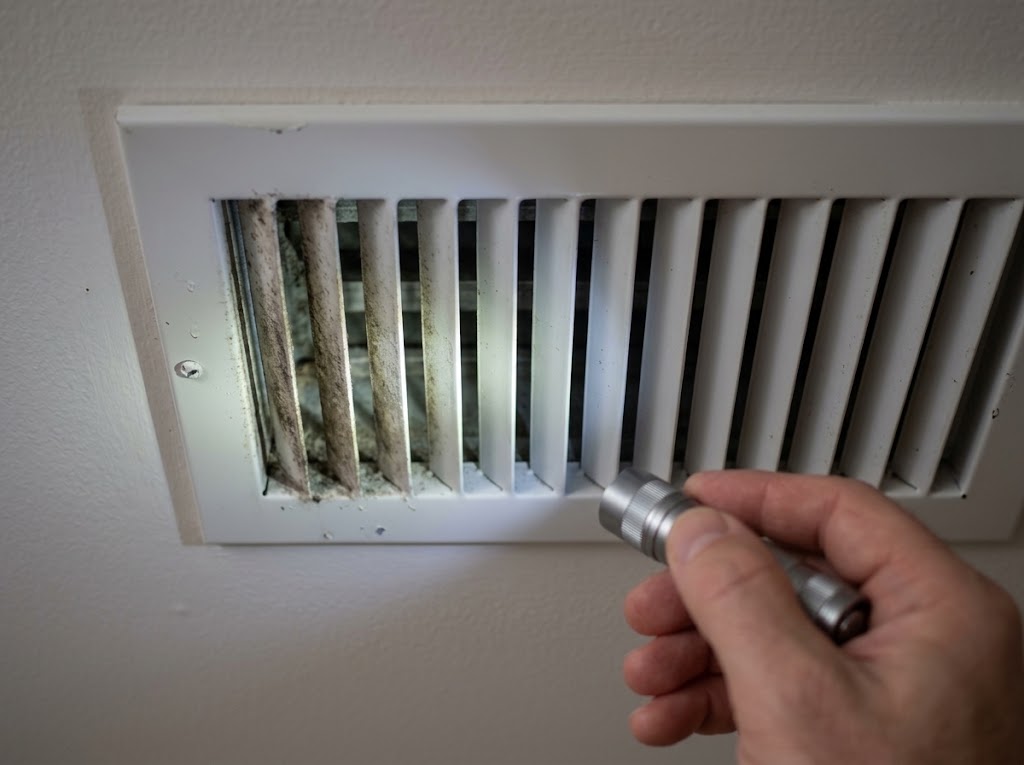
Checking a few vents room by room tells you whether you are dealing with the coil or a section of duct.
What you can check yourself in ten minutes
Before you call anyone, a few minutes of checking tells you a lot about which of the four causes you are looking at.
Pull your air filter and look at it. A filter that is gray, matted, or visibly dirty is feeding a coil that is more likely to be growing something. Note when the smell shows up. A smell that is strong for the first minute the system runs and then fades usually points to the coil or a nearby pan, since that is where stagnant, humid air collects between cycles. A smell that stays constant the whole time the system runs points more toward ductwork.
Walk the house room by room with the AC running and stand under each vent for a few seconds. If one room is noticeably worse than the rest, you are very likely dealing with a duct section in that part of the attic rather than a whole-house coil problem. If every room smells about the same, the coil or the central return is the more likely source. If your air handler is in a closet or garage, open it and look at the drain pan underneath the coil. Standing water that has not overflowed, even a small amount, tells you the pan is draining too slowly.
When it is more than a nuisance
A musty smell is worth taking seriously beyond comfort. The CDC notes plainly that mold can smell musty, and if you see or smell it, you should remove it. The EPA adds that mold exposure is a recognized trigger for allergy and asthma symptoms in sensitive people, and that mold, along with dust mites and other biological contaminants, can cause coughing, wheezing, and nasal inflammation. That does not mean every musty AC smell is a health emergency. It does mean a smell that keeps coming back is not something to live with indefinitely, especially in a household with young kids, older adults, or anyone with asthma or allergies.
Fixing it for good, and when to call a pro
Some of this is genuinely a homeowner job. A dirty filter is a five-minute fix, and if the smell disappears after a fresh filter and a few days of normal running, that may have been the whole problem. Wiping visible dust and light residue off an accessible vent register with a damp cloth is also fine to do yourself.
Call a licensed technician when any of the following is true: the smell comes back within a few weeks of changing the filter, you can see mold growth on the coil or in the ductwork that you cannot reach or clean yourself, the smell is paired with allergy or asthma symptoms that improve when you leave the house, or you have already checked the filter and the pan and neither explains it. A technician can clean the evaporator coil properly, which is not a simple wipe-down since the coil's fins are fragile and packed tightly together, inspect the ductwork for hidden moisture or a failed seal, and confirm the condensate pan is draining the way it should.
If the cause turns out to be ongoing moisture rather than a one-time dirty coil, an indoor air quality upgrade is worth discussing. We cover one common option, a UV air treatment system that reduces microbial growth on the coil, in our guide to whether you need a UV light in your AC system. Our indoor air quality services cover the fuller range of filtration and treatment options if a musty smell has become a repeat visitor in your home.

Coil fins are fragile and tightly packed, which is why a real cleaning is a technician's job.
Simple Action runs licensed, certified, and insured AC service across Palm Beach County with upfront pricing before any work starts and an on-time arrival promise. If the smell keeps coming back and you are ready for someone to find the actual source, call us at 561-234-4224. One call, one price, one visit.
Keeping it from coming back
Change your filter on a real schedule. ENERGY STAR recommends inspecting or changing your filter once a month, and in Florida's long cooling season, that monthly habit matters more here than almost anywhere else in the country, since the coil behind that filter almost never gets an off-season.
Book an annual tune-up. ENERGY STAR's maintenance checklist also calls for a seasonal professional check-up that includes cleaning the coils and inspecting the condensate drain, which is exactly the combination that prevents a musty smell before it starts. That is the core of a proper AC maintenance and tune-up visit, and it is why Simple Care Club members rarely deal with this problem at all.
If you are heading north for the season, do not shut the system off entirely. Leaving the AC running at a higher setpoint keeps the house dehumidified while you are gone, instead of leaving warm, humid, still air sitting in a closed house for weeks. A programmable or smart thermostat makes this easy to set and forget.
Honest diagnosis, narrow arrival windows, and respect for your home are how we work across Palm Beach County. If a musty smell is showing up every time the AC kicks on, call Simple Action and we will find the actual source, not just mask it.
Frequently asked questions
Is a musty AC smell dangerous?
Not automatically, but it is worth taking seriously. The CDC notes that mold can smell musty and should be removed when you see or smell it, and the EPA links mold exposure to allergy and asthma symptoms in sensitive people. A smell that shows up once and clears with a filter change is a minor issue. A smell that keeps returning means active mold growth somewhere in the system, and that is worth diagnosing rather than living with.
Can I fix a musty AC smell myself?
Sometimes. Start with the filter, since a dirty filter feeding a wet coil is the single most common cause. If a fresh filter clears the smell within a few days, that was likely the whole problem. If the smell returns, or if you can see mold growth you cannot reach, the coil or ductwork needs a technician, since a coil's fins are too fragile for a rough cleaning and hidden duct sections are not something you can safely inspect yourself.
Why does my AC only smell musty when it first turns on?
Because that is when stagnant, humid air trapped near the coil or a slow-draining pan gets pushed through the house first. Once fresh air has been moving for a minute or two, the smell often fades because it is being diluted rather than eliminated. That pattern usually points to the evaporator coil or the condensate pan rather than the ductwork.
Why does the musty smell show up in only one room?
This usually means a section of ductwork, not the coil. Ducts that run through a hot Florida attic can develop condensation where insulation or a seal has failed, and dust sitting in that section of duct gives mold a place to grow. A whole-house cause like the coil tends to smell roughly the same from every vent, while a smell that is clearly worse in one room points to the duct feeding that specific room.
Does a musty smell mean I have mold in my ductwork?
It is one of the more likely explanations, especially if the smell is stronger in one room or near one vent, but it is not the only one. A wet evaporator coil and a slow-draining condensate pan cause the same symptom. Checking whether the smell is whole-house or localized to specific vents is the fastest way to narrow it down before calling for an inspection.
Will a bigger AC unit fix a musty smell?
No, and an oversized system is more likely to cause the problem than fix it. A system that is too large for the house cools the air quickly and shuts off before it has removed much humidity, since most moisture removal happens later in a cooling cycle. That leaves the coil wetter, more often, which feeds mold rather than starving it. Correct sizing, not a bigger unit, is what actually helps.
Reviewed by the Simple Action Air Conditioning team. Licensed, certified, and insured in Florida, license CAC1824605. Serving Palm Beach County 24/7.