Why Is My AC Leaking Water Inside?
Vardan Hovhannisyan
Co-Founder

Date & Time
You walked past the air handler closet and the floor was wet. Maybe a brown ring is spreading on the ceiling under an attic unit, or the system went quiet and stopped cooling. First, take a breath. In Palm Beach County, water inside the house almost never means your air conditioner is dying. It means water that should be leaving the house has nowhere to go.
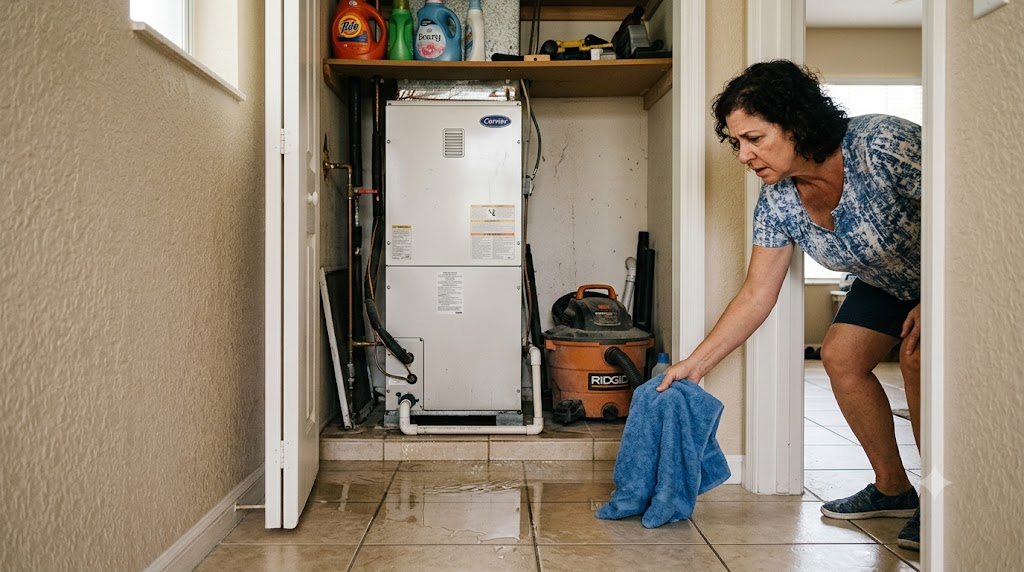
A wet floor by the air handler is the classic sign of a backed-up condensate line.
The short version: it is almost always the condensate drain line
Here is the honest answer most homeowners are looking for. Nine times out of ten, an air conditioner that leaks water inside the house has a clogged condensate drain line. Your AC pulls a surprising amount of moisture out of South Florida air, that water collects in a pan, and a small pipe carries it outside. When that pipe clogs, the water backs up and spills onto your floor, your ceiling, or your closet wall.
The U.S. Department of Energy puts it plainly. Clogged drains reduce the unit's ability to remove condensed water, which forces the system to shut off until the drain clears or lets the blocked line overflow. So if you found standing water and a system that quit on its own, those two facts are the same story.
The good news for Palm Beach County homeowners: a clogged line is one of the cheapest and most preventable problems an AC has. You can stop most clogs with a thirty-second habit. The rest of this guide walks through why it happens here so often, how to clear it safely, and when standing water means something deeper.
Why Florida AC systems leak more than most
Three things stack up against us down here, and they all feed the same drain line.
First, the humidity. Warm, humid indoor air gets pulled across a cold evaporator coil, and the moisture in that air condenses into water, the same way a glass of iced tea sweats on the lanai. Lennox describes the cycle well: the air reaches its dew point on the coil and the moisture drips into a pan and out through the drain line. The more humid the air, the more water your system makes. In Palm Beach County, that is gallons on a muggy August day.
Second, the runtime. Up north an AC rests for half the year. Here it runs hard from March into November and ticks along even in winter. More runtime means more condensation moving through that one small pipe, day after day.
Third, the biology. Warm, damp, dark PVC is a perfect home for algae and mold. That slime is what actually plugs the line. The Department of Energy specifically flags humid conditions as the reason to keep an eye on the condensate drain and recommends flushing the line to hold back mold growth. Salt air near the coast adds one more wrinkle by rusting older metal drain pans from the inside out.
How the condensate drain line works, and how it clogs
Picture the path the water takes. It starts on the cold evaporator coil inside your air handler, drips into a shallow drain pan underneath, and flows by gravity into a white PVC pipe. That pipe runs out through a wall or down to a floor drain. When everything works, you see a steady drip outside the house and nothing inside.
Most systems also have a backup. Lennox notes there is usually a secondary drain pan and a secondary line that drains above a window or door as a fail-safe. So here is a useful tell. If you see water dripping from a pipe over a window outside, that is not a quirk. That is your backup line warning you the primary line is blocked. Do not ignore it.
The clog itself builds slowly. Dust from your filter, plus the algae that loves our climate, hardens into a plug somewhere in the pipe or right at the pan outlet. Water rises in the pan, finds the lip, and goes over the side. That is the puddle on your floor.
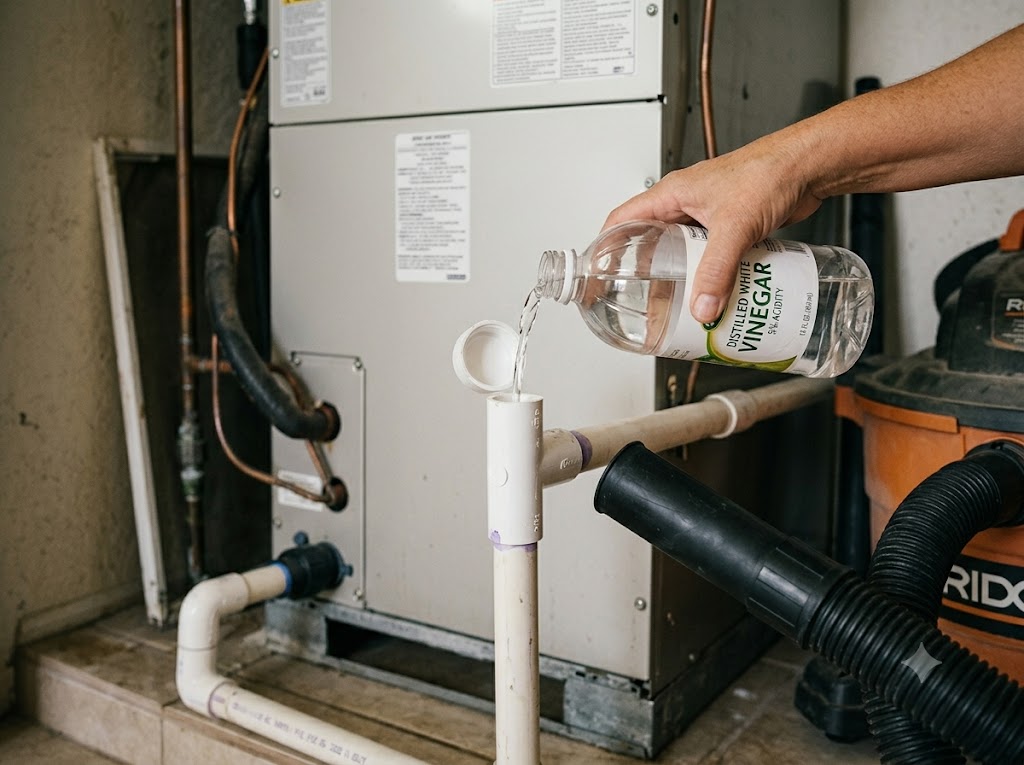
The access port on the PVC line is where you flush and where you clear a clog.
The other causes worth ruling out
The drain line is the usual suspect, but it is not the only one. Walk through these before you assume the worst.
A frozen evaporator coil. A dirty filter or a low refrigerant charge starves the coil of airflow, the coil ices over, and when that ice melts it overruns the pan all at once. Carrier lists a frozen coil as a leading cause of a leaking air conditioner. If you spot ice on the copper lines or the coil, shut the system off and let it thaw before you do anything else.
A cracked or rusted drain pan. Older systems, and coastal systems that fight salt air, develop a pan that rusts through or splits. Carrier points to a corroded or damaged drain pan that no longer channels condensation away. The pan looks fine until you shine a light under it and find the pinhole.
A failed condensate pump. Some Palm Beach County homes, especially condos and homes where the air handler sits below the drain, use a small pump to push water out. When the pump quits, the water simply stops moving and overflows.
A bad slope or a disconnected line. A line that sags or was installed without enough downhill pitch holds water in a low spot, which then breeds more algae and clogs faster. A line that worked loose at a joint just dumps water wherever it ends.
What to do the moment you see water
Move fast on the first two steps. The rest can wait until you have a towel and a flashlight.
Turn the system off at the thermostat. Set it to off, not just up a few degrees. Running a leaking system pushes more water into a place it should not be, and Carrier flatly advises that you should not run an AC that is leaking water until the cause is fixed. If your system already shut itself off, leave it off. A float switch did its job and tripped to protect your floors.
Then soak up the standing water before it reaches drywall, baseboards, or the ceiling below an attic unit. A wet floor is a nuisance. A soaked ceiling is real damage. Pull the filter while you are there and look at it. A filter caked gray is a strong hint that a frozen coil, not the drain line, started this.
Clearing the line yourself, and when to call a pro
Caught early, a clogged condensate line is a job many homeowners handle. Here is the safe version of the steps the manufacturers themselves recommend.
Kill the power. Off at the thermostat and at the breaker. You are about to mix water and electricity, so do not skip this.
Find the access port. Look for the white PVC pipe near the air handler with a removable cap, often a T-shaped fitting. That is your way in.
Clear the pan. If water sits in the drain pan, vacuum or sponge it out so you can see what you are working with.
Pull the clog with suction. A wet/dry shop vacuum on the outdoor end of the line, sealed with a rag, pulls the plug out in a minute or two. Lennox recommends a wet/dry vacuum to suck out the clog, then a vinegar flush left to sit before rinsing.
Flush the line. Pour a cup of distilled white vinegar into the access port, wait about thirty minutes, then run clean water through to confirm it flows.
Now the honest part. Some leaks are not a do-it-yourself job, and pretending otherwise just turns a small problem into a big one. Call a licensed technician when the clog comes back within weeks, when you see rust or water damage around the unit, when a musty smell rolls out of the vents, or when the line still will not flow after you have vacuumed it. Lennox flags the same red flags: recurring clogs, standing water and rust, and moldy odors all point to a deeper issue that wants the right tools. A recurring clog usually means a sag in the line or a problem at the pan, and that is worth a professional eye before it rots a subfloor or a ceiling.
If you are staring at a wet ceiling at two in the morning, that is exactly what our team is for. Simple Action runs emergency AC service across Palm Beach County, 24/7, with an on-time arrival promise and upfront pricing before any work starts. One call, one price, one visit.
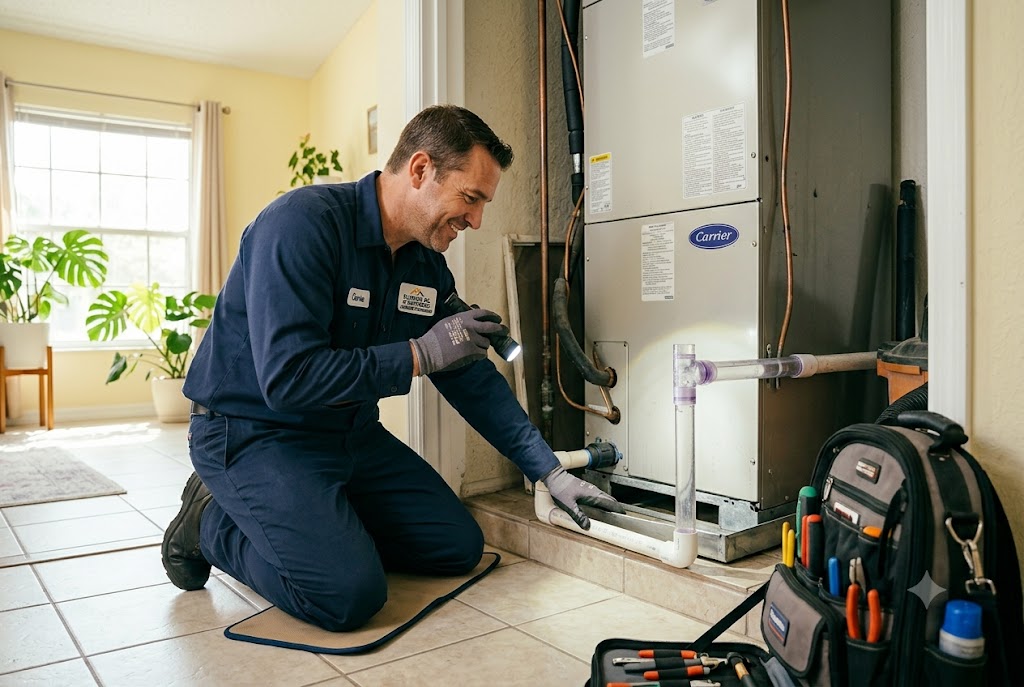
When the clog keeps coming back, the line itself needs a closer look.
How to keep it from happening again
This is the part that saves you the wet floor next summer. Prevention here is simple and it works.
Flush the line every three months. Pour a cup of distilled white vinegar into the access port quarterly. It takes thirty seconds and stops the algae before it ever becomes a plug. The Department of Energy recommends the same idea, to periodically flush the drain line to prevent mold growth. In our climate, put it on the calendar for the first of every season change.
Change your filter on a real schedule. A clean filter protects the coil, and a protected coil does not freeze and flood the pan. Carrier advises replacing filters every one to three months, and the Department of Energy says every month or two during the cooling season. With our long cooling season and the dust that comes with it, lean toward the shorter end.
Book a real tune-up once a year. A technician clears the line under pressure, checks the pan and the float switch, and catches a rusted pan or a failing pump before it leaks. That is the heart of a good AC maintenance and tune-up visit, and it is why our Simple Care Club members rarely meet a clogged line in the first place. If your real complaint is a clammy, sticky house rather than a puddle, that is a different problem worth reading up on in our guide to why a house stays humid with the AC on.
Honest assessments, narrow arrival windows, and respect for your home are how we work across Palm Beach County. Call Simple Action at 561-234-4224 and we will sort the leak today.
Frequently asked questions
Is it safe to run my AC while it is leaking water?
No. Turn the system off at the thermostat. Running it pushes more water where it does not belong and risks damaging the coil, the controls, and your floors or ceiling. Carrier advises against running an air conditioner that leaks until the cause is fixed. If a float switch already shut the system down, leave it off until the line is clear.
Can I clear a clogged AC drain line myself?
Often, yes, if you catch it early. Cut the power, find the white PVC access port near the air handler, pull the clog with a wet/dry vacuum on the outdoor end, then flush the line with a cup of distilled white vinegar. If the clog returns quickly or the line still will not drain, the problem sits deeper and wants a licensed technician.
How much water should drain from my AC on a humid day?
More than people expect. A central system in Palm Beach County pulls gallons of moisture out of the air on a muggy day, all of it routed through one small line. That steady volume is exactly why the line clogs here faster than it does up north, and why a quarterly flush matters so much.
Why does my AC only leak when it is humid or rainy outside?
Humid air means more condensation crossing the coil, so the drain line carries its heaviest load on the muggiest days. A line that is partly clogged keeps up when the air is dry and overflows when the humidity spikes. The leak that shows up only in a August downpour is usually a line that is already half blocked.
How often should I flush my AC drain line in Florida?
Every three months. A cup of distilled white vinegar in the access port, four times a year, prevents the algae and mold that cause most clogs in our climate. Pair that with annual professional maintenance and a fresh filter, and a leaking line stops being something you worry about.