How Often Should You Service Your AC in Florida?
Vardan Hovhannisyan
Co-Founder

Date & Time
Ask ten websites how often to service your air conditioner and most of them land on the same answer: once a year. That advice works fine in Ohio. It falls short on a barrier island in Palm Beach County, where your system runs almost every day and breathes salt air a few blocks from the water. The runtime here is different, the corrosion is different, and the maintenance schedule has to match.
Here is the short version, then the reasoning, so you can decide what your own home needs.

The short answer: twice a year for most Palm Beach County homes
For the typical home in Palm Beach County, book professional AC service two times a year. Schedule the main tune-up in spring, before the heat and humidity peak, and a second visit in early fall to catch anything that wore down over the long cooling season. ENERGY STAR recommends annual pre-season check-ups for heating and cooling equipment, with the cooling system checked in spring. In a climate where the AC barely gets a winter break, two visits keep the system honest and catch small faults before a July afternoon turns them into a no-cool call.
Between those professional visits, you handle one job on your own: the air filter. More on that below. The split is simple. You keep air moving. A licensed technician handles the parts that need tools, gauges, and training.
Why Florida changes the maintenance math
Up north, an air conditioner sits idle from October through April. Here, it runs close to year-round. That extra runtime piles up wear on the blower motor, the compressor, the contactor, and the capacitor far faster than a northern system collects it. A once-a-year schedule built for a four-month cooling season leaves a South Florida system under-serviced for the back half of the year.
Salt air adds a second problem that inland guides skip entirely. Homes near the Intracoastal and the ocean in Palm Beach, Jupiter, and the barrier-island neighborhoods sit in a corrosive zone. Salt accelerates rust on the outdoor condenser coil and the cabinet, and a corroded coil sheds cooling capacity every season. Coastal exposure is one reason systems here often last 8 to 10 years instead of the 15 you read about elsewhere, a point we cover in our guide to how long AC units last in coastal Florida. Twice-a-year service gives a technician the chance to rinse the coil, treat early corrosion, and slow that clock down.
Humidity is the third factor. Your AC pulls gallons of water out of the air every day, and all of it drains through a single condensate line. The Department of Energy notes that a clogged drain reduces the unit's ability to remove condensed water and can cause the equipment to shut off or overflow into the home. In a humid climate that line clogs faster, which is exactly why so many homeowners search for why their AC is leaking water inside. A maintenance visit clears that drain before it backs up.
What an honest AC tune-up actually includes
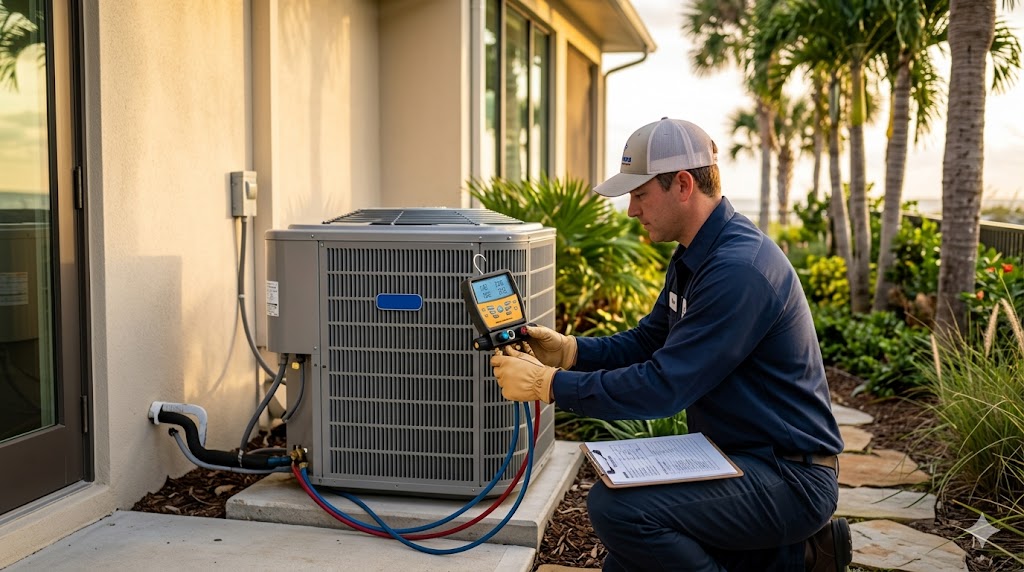
Not every visit billed as a tune-up earns the name. A real one is hands-on and takes time. The Department of Energy lays out what a qualified technician should do: check the refrigerant charge and test for leaks, measure airflow across the evaporator coil, verify the electrical control sequence, tighten electrical connections, oil motors, check the belts, and confirm the thermostat reads accurately. ENERGY STAR adds that dirty coils and low or high refrigerant both force the system to run longer, which drives up energy costs and shortens equipment life.
Here is the part that protects your wallet. A technician who shows up, glances at the unit for ten minutes, and tries to sell you a recharge or a part you did not ask about is running a script, not a tune-up. South Florida sees a lot of that, and we wrote a full breakdown of the AC repair scams common in Palm Beach County so you know the red flags. A proper visit produces a clear report on what passed, what needs watching, and what needs action, with no pressure attached.
What you handle yourself between visits
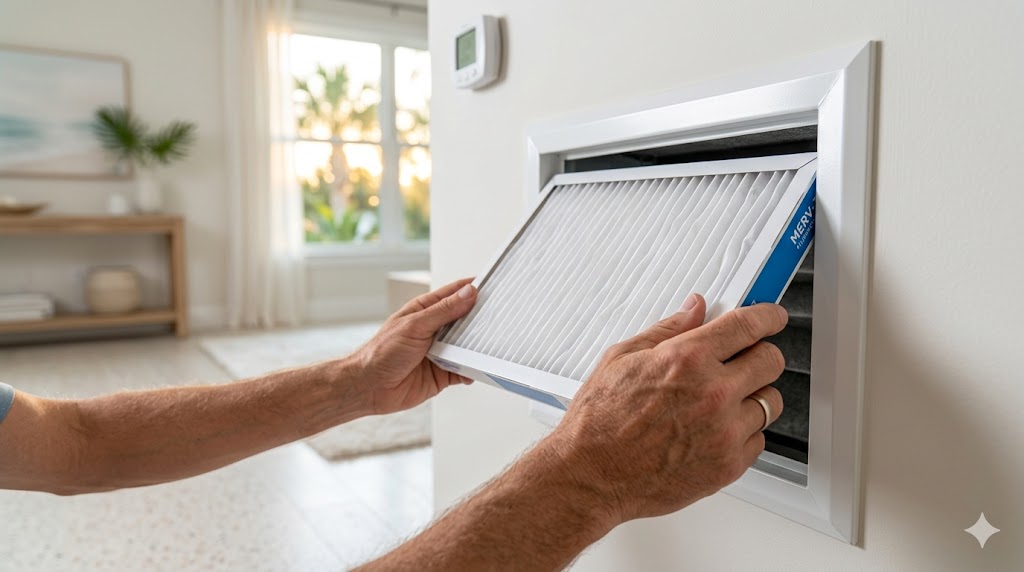
The single most valuable thing you do for your AC costs you a few minutes: change the filter. ENERGY STAR advises you inspect, clean, or change the filter once a month, and warns that a dirty filter increases energy costs and damages equipment, leading to early failure. The Department of Energy points to the same fix, recommending you clean or replace filters every month or two during the cooling season, and more often if you run the system constantly, live in dusty conditions, or have pets. In Palm Beach County, where the cooling season never really ends, treat the monthly check as the rule.
A clogged filter does more than waste energy. It starves the system of airflow, and ENERGY STAR notes that airflow problems alone reduce a system's efficiency by up to 15 percent. Starved airflow also lets the coil freeze and leaves your house clammy, which is the hidden cause behind a lot of complaints about a house staying humid with the AC running.
Two more jobs belong to you. Keep the outdoor unit clear: the Department of Energy advises trimming foliage back at least two feet around the condenser so air moves freely. And give the unit a quick look after storms, since debris and standing water collect fast here. Everything past that, the refrigerant, the electrical, the coil cleaning, belongs to a licensed technician.
Signs your AC is overdue for service
Your system tells you when it has gone too long. Warm air from the vents, weak airflow, a spike in your power bill with no change in the weather, water around the indoor unit, or new clanking and buzzing sounds all point to a system that needs attention now. Rising humidity indoors is another tell, since a struggling system loses its grip on moisture before it loses its grip on temperature.
When the air turns warm in the middle of a heat advisory, that is not a wait-and-see problem. Our team runs 24/7 emergency AC service across Palm Beach County for exactly that reason. Most of those midnight calls trace back to a fault a spring tune-up would have flagged months earlier.
When once a year is enough, and when you need more
Twice a year fits most homes here, but your situation shifts the dial. A newer system, a few miles inland, in a home without pets, stays healthy on one thorough spring visit plus your own monthly filter checks. A system within a mile of salt water, a home with multiple pets, a rental you do not live in day to day, or any unit already past the 8-year mark earns the second visit and sometimes a third. Salt-zone condensers especially benefit from an extra coil rinse partway through the summer.
Snowbird homes follow their own rhythm. A house that sits closed for months needs a startup check before the season and a shutdown check after, so the system is not left running unmonitored or sitting damp with the drain unattended. If you split your year between Palm Beach County and somewhere cooler, build service around your arrival and departure rather than the calendar.
How a maintenance plan keeps you on schedule
The hard part of AC maintenance is not the work. It is remembering to book it twice a year while life moves on. A membership solves that by putting the visits on a schedule for you. Our Simple Care Club covers the seasonal tune-ups, keeps a record of your system's history, and gives members priority when the heat breaks something. You get the same upfront pricing promise, the same on-time arrival, and the same respect for your home on a planned visit that you get on an emergency one. If you would rather book service one visit at a time, our AC maintenance and tune-up page walks through what each visit covers across Palm Beach County.
Whichever route you pick, the goal is the same. Keep the filter clean, keep the outdoor unit clear, and get a trained technician on the system twice a year. Do that, and you trade the surprise breakdown for a system that holds its cool through the longest South Florida summer.
Frequently asked questions
How often should you service your AC in Florida?
Service your AC two times a year in Florida: a spring tune-up before peak heat and a fall check after the long cooling season. The system runs close to year-round here, so the once-a-year schedule built for northern climates leaves it under-serviced. Homes near salt water or with older systems benefit from an extra mid-summer coil visit.
Is AC maintenance really necessary every year?
Yes. The Department of Energy states that regular maintenance of the filters, coils, fins, and refrigerant lines is essential for efficient performance, and that neglecting it leads to declining performance and rising energy use. Annual service is the floor. In Florida's year-round cooling climate, two visits protect the system better than one.
What happens if you don't service your AC?
Skipped maintenance shows up as higher power bills, weaker cooling, a clammy house, and shorter equipment life. Dirty coils and a clogged drain make the system run longer and harder, and small faults that a tune-up catches early grow into compressor failures and mid-summer breakdowns. The repair almost always costs more than the visit that would have prevented it.
How long does an AC tune-up take?
A thorough tune-up runs about one hour for a single system in good shape. A technician checks the refrigerant charge, tests for leaks, measures airflow, inspects electrical connections, clears the condensate drain, and cleans the coils. A unit that needs cleaning or minor correction takes longer. A ten-minute glance is not a real tune-up.
Can I service my own AC?
You handle the airflow side yourself: change the filter monthly, keep the outdoor unit clear of foliage by at least two feet, and rinse off debris after storms. Leave the refrigerant, electrical, and coil work to a licensed technician. Refrigerant handling is regulated, and a wrong move there damages the system or voids the warranty.